The possible phonetic interference from the later-acquired language on the earlier-acquired ones in stop acquisition has hardly been investigated among trilinguals with Asian language backgrounds. This study addressed this research gap. It explored how L3 Japanese acquisition experience influences Mandarin sequential trilinguals’ production and perception of word-initial voiceless stops in L2 English and L1 Mandarin. Thirty-one Mandarin trilinguals who were upper-intermediate in English and advanced in Japanese completed a production experiment by reading English and Mandarin words containing the target stops. They also completed a perception experiment, identifying synthetic stimuli along bilabial, alveolar, and velar stop continua in both Mandarin and English. The stimuli of each continuum were words whose word-initial stops had VOT values ranging from –40 to 130 ms in 10-ms increments. The trilinguals’ phonetic performance was compared with that of both Japanese bilinguals and Mandarin bilinguals. The inter- and intra-group differences consistently supported profound L3-on-L2 effects: the trilinguals’ VOT values and perceptual category boundaries for English voiceless stops differed significantly from those of the Mandarin bilinguals, but aligned more closely with those of the Japanese bilinguals; the trilinguals exhibited significantly different VOT values and category boundaries between the target English and Mandarin stops. However, the results revealed less prominent L3-on-L1 effects. Our results are in line with the predictions of the revised Speech Learning Model.
This study explored the acquisition of Japanese word-initial voiceless stops by Mandarin trilinguals with advanced proficiency in their third language Japanese. The relationship between their full-time equivalent (FTE) years of Japanese input and their production and perception of these stops was also investigated. Mandarin trilinguals and Japanese bilinguals completed an experiment by producing Japanese words with the target stops and another experiment by listening to Japanese stop continua with synthetic stimuli varying in voice onset time (VOT) values. The results showed that the Mandarin trilinguals produced the target stops with longer VOT values than the Japanese bilinguals, and perceived the stop continua with category boundaries at longer VOT values than the bilinguals. The trilinguals’ production and perception skills revealed phonetic interference from both their native Mandarin and second language English. The correlation analysis between the trilinguals’ FTE and their mean VOT values and mean category boundaries indicated that longer FTE for trilinguals may not directly translate into target-like performance.
This study targets Mandarin trilinguals with advanced proficiency in L3 Japanese, exploring their production of L2 English word-initial voiceless stops. Thirty-one Mandarin trilinguals, 34 Japanese bilinguals, and 26 Mandarin bilinguals produced nine English words containing word-initial /p, t, k/. The VOT values of each stop were measured. Results showed that the Mandarin trilinguals produced the target stops with mean VOT values falling between those of the Japanese and Mandarin bilinguals. These results suggest that the Mandarin trilinguals' production of English stops were influenced by the phonetic systems of both L1 Mandarin and L3 Japanese.
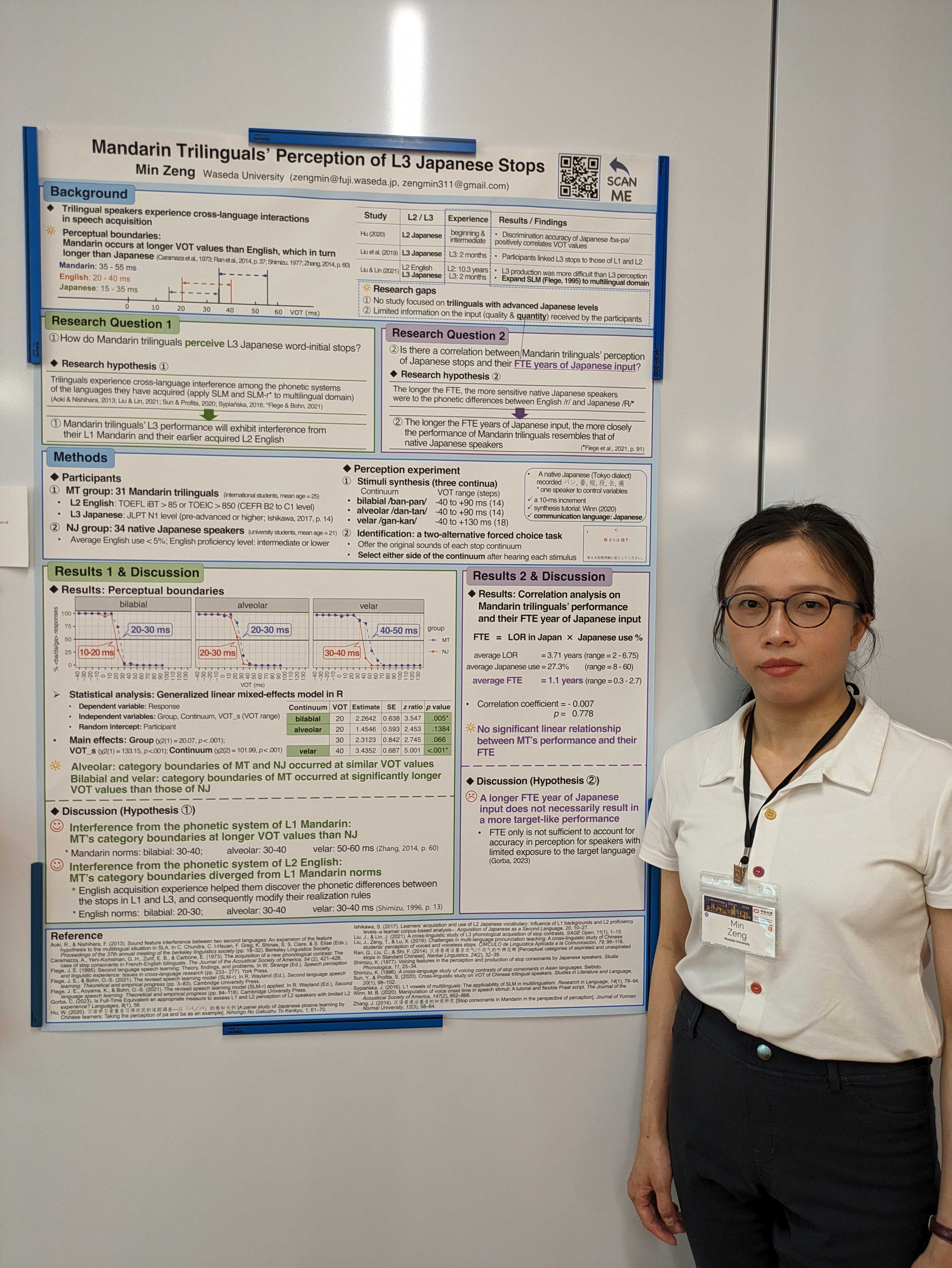
This study explored the acquisition of Japanese word-initial voiceless stops by Mandarin trilinguals with advanced proficiency in their third language Japanese and the relationship between their full-time equivalent (FTE) years of Japanese input and their perception of these stops. Thirty-one Mandarin trilinguals and 34 Japanese bilinguals completed a perception experiment by listening to Japanese stop continua with synthetic stimuli varying in voice onset time (VOT) values. The results showed that the Mandarin trilinguals perceived Japanese stops with category boundaries occurring at longer VOT values than the Japanese bilinguals. The trilinguals' perception skills revealed phonetic interference from both their native Mandarin and second language English. The correlation analysis between the trilinguals' FTE and their mean category boundaries indicated that longer FTE for trilinguals may not directly translate into target-like performance.